
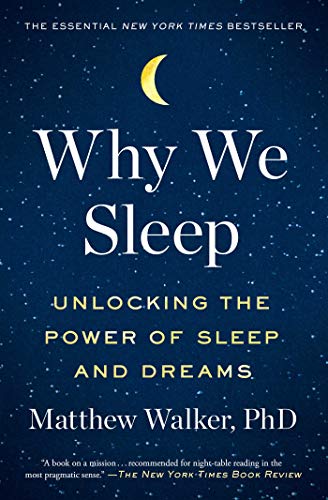
My whole life I've been one of those people that considered sleep a little bit of a waste of time. Leaving time management issues asside, it seemed to be an obstacle that hindered productiveness; something that took away many hours that could be put into doing many other things, even for recreation. It seemed like a weakness of the human beings. This book has changed my vision.
From the very beginning of this book, you can tell that the author is completely passionate about the topic of sleep. Fortunately, even though there is some scientific terminology in the book, the author has made it very easy to digest, and communicates the ideas effectively. The book is not just a bunch of theories or opinions from the author; every chapter is built on different studies from different scientists, so the full content comes across as a very serious topic, that can persuade skeptics like me. On some of the studies I would try to skip ahead and start thinking about flaws in the study, and immediately afterwards the author addresses those concerns, usually giving very solid conclussions.
Here is a summary of the contents of this book:
Are you getting enough sleep?
- Could you fall back asleep at 10-11am if you tried to?
- Can you function optimally without caffeine before noon?
- Would you sleep way past your waking time if you didn't set an alarm?
- Do you sometimes find yourself at your computer reading and re-reading the same sentence?
Dangers of sleep depravation
Negative effects on your brain
- Sleeping 6 hours every night, for 10 nights in a row, make you as impaired as if you had been awake 24 hours straight. Even after 3 nights of recovery, your performance level might not be fully recovered.
- People usually underestimate how their performance has deteriorated.
- If you drive after sleeping only 5 hours, you are 3 times more likely to suffer an accident. If you drive after sleeping only 4 hours, this increases to 11.5 times.
- After 22 hours of sleep depravation, you are as cognitively impaired as those who are legally drunk.
- Being awake for 17 hours is similar to having a BAC of 0.05% (Blood Alcohol Concentration).
- Being awake for 24 hours is similar to having a BAC of 0.10%.
- The United States defines legal intoxication for purposes of driving as a BAC of 0.08%.
- Driving impairments are seen at a BAC of 0.05%
- Car crashes caused by drowsiness tend to be more fatal than those caused by alcohol.
- If you fall asleep at the wheel, you stop reacting altogether; whereas a drunk driver still reacts, only slower.
- Don't think that you can keep yourself awake at the wheel, and fight the sleep signals you body sends you. You must stop.
Negative effects on your body
- Short sleep has been associated with a significant increase of the risk to suffer a coronory heart disease.
- Sleeping less than 7 hours a night increases the probability of gaining weight, and increases the likelihood of developing type 2 diabetes.
- Inadequate sleep reduces the amount of the hormone that makes you feel full after eating, and on the other hand increases the amount increases the amount of the hormone that produces a desire to eat.
- Your body becomes unable to manage the extra calories efficiently. It becomes less effective in absorbing glucose and maintaining the level of sugar in your blood.
- Men with inadequate sleep have lower levels of testosterone. With lower levels of testosterone:
- Men feel tired throughout the day
- It is more difficult to concentrate on work tasks
- Women working erratic hours have a reduced ability to get pregnant.
- Pregnant women sleeping less than 8 hours a night are more likely to suffer a miscarriage.
- The less you sleep, the more likely you are to catch a cold.
- Sleep disruption may increase the risk of cancer development, and may favour its rapid growth.
- The World Health Organization has classified nighttime shifts as a "probable carcinogen".
The evolutionary benefits of sleep
- Sleep helps in our ability to learn
- Sleeping before learning prepares your brain to make new memories
- Sleeping after learning helps to cement the new memories considered important, and also to forget those considered irrelevant (keeping free space available for the important memories)
- Sleep also works as a recovery service for things that could otherwise be forgotten.
- Regarding motor skills,
- your brain continues to improve those skills in the absence of practice. When trying to play a difficult piece of piano that you cannot play before going to bed, you might find that it is a lot easier after sleeping.
- You can get 20% improvement in performance speed, and 35% of improvement in accuracy.
- Sleep helps us make logical decisions
- Sleep helps us navigate social and psychological challenges
- Dreaming takes the pain out of difficult emotional episodes; i.e., it isn't "time" alone which heals all wounds... it is time spent dreaming.
- Dreaming helps us in tuning our internal decoder of emotions in facial microexpressions.
- Dreaming provides us with creativity and problem solving skills
- While we sleep, our brain looks for associations that wouldn't be obvious while we are awake.
- Sleep strengthens our cardiovascular health
- Sleep strenghtens our entire immune system
How should we sleep?
- Ideally, studies keep showing that we should sleep 8 hours. As you start sleeping less than that, you start losing the benefits of sleep, and start suffering the consequences. Humans need at least 7 hours to maintain cognitive performance, which is the minimum recommended by the CDC.
- There is no sleep credit. You cannot really recover 100% of the sleep you have lost.
- We should wake up every day at the same time, even on weekends. Maintain a stable sleep schedule.
- Don't use alarm clocks. Your body is capable of logging time with a remarkable precision while you are sleep. If you keep a stable sleep schedule, your body will wake up at the same time every day (Of course, if you need to get to the airport at 4am, you should use an alarm). It is even recommended to use alarms the other way around: set the alarm to indicate that it is time to go to bed.
- Waking up with the sound of an alarm can cause spikes in your blood pressure and your heart rate.
- Never use the "snooze" button. It would repeate those spikes over and over again.
- If you like to exercise at night, you should do it at least 3 hours before you go to bed.
- Avoid alcohol drinks before bed. It dramatically reduces your sleep quality.
- Even if it knocks you out, you are not getting a naturalistic sleep, with all its benefits, especially from REM sleep.
- Drinking 3 days after learning something new would dramatically cause a loss of those things you learned, after you would think that those memories are safely stored in long-term memory.
- It takes too many hours for your body to degrade the alcohol.
- Avoid large meals before bed. They also have an impact on your sleep quality.
- Take a hot bath before bed. Your body feels sleepy after the drop in body temperature.
- Washing your face also helps you sleep better, because it also helps to decrease your body temperature.
- Get rid of anything in your bedroom that might distract you (TV, cell phone, computer, clocks, etc).
- Ideally, you should turn off devices 2 hours before going to bed. The light from the devices messes up with how your body produces the hormones that help you sleep.
- This especially happens with blue LED light. Most devices and screens have "eye saver" modes that reduce the amount of blue light. You must definitely use that, but it is just a little help, a damage control mechanism, that doesn't remove the need to turn off the devices way before bedime.
- Don't lie awake in bed. If you are more than 20 minutes in bed without falling asleep, get out of bed.
- Get at least 30 minutes of natural sunlight every day.
- Senior citizens should go out in the late afternoon, to push their bedtime to a later hour.
- Get a midafternoon short nap, before 3pm. Biphasic sleep is not cultural in origin, it is deeply biological, even though only some cultures have maintained it. All humans have a genetically hardwired dip in alertness that occurs in the midafternoon hours. Our society has driven us away from that biological need, and most people end up drinking caffeine.
- Avoid caffeine
- Avoid sleeping pills
Changes in sleep across our life span (important for parents)
- NREM/REM sleep
- A 1 year-old has 50/50 NREM/REM sleep, across 14 hours of sleep
- A 5 years-old has 70/30 sleep, across 11 hours
- Late teens: 80/20, across 8 hours
- Circadian rhythm:
- Our circadian rhythm changes through our life span; sometimes it shifts forward, sometimes backwards.
- Young children need to go to sleep earlier than most adults.
- Adolescents need to go to sleep later than most adults.
- Asking an adolescent to get up at 5-6am to go to school could be equivalent to asking an adult to get up at 3-4am to go to work. Most people are not aware about this biological reality and what our societies are asking us to do with our children. Many parents end up criticizing their children for not going to bed early, at a time when their bodies are signaling them that it is not yet time to sleep.
- Senior citizens need to go to sleep earlier than most adults.
- Older adults do not need less sleep, as some people think. They are just not able to generate it.
- By your late 40s you would have lost 60%-70% of the deep sleep you were able to get when you were younger.
- By your 70s, you would have lost 80%-90%
- Ideally, they should get sunlight exposure late in the afternoon, to delay the release of melatonin, and therefore push bedtime to a later hour, increasing sleep pressure, and helping get a better sleep quality.
What our societies are doing wrong
Caffeine
- This is the most widely used drug. It is highly addictive, and many people give it to their children and teens.
- Caffeine blocks and inactivates the receptors of the chemicals that build the sleep pressure that makes us want to sleep. Therefore, it just numbs your body and tricks it into thinking that you don't need to sleep.
- The chemicals continue to build up even under effects of caffeine; you just don't feel it. Once your liver dismantles the caffeine, all of a sudden your are hit with the complete sleep pressure that has been building up (a "caffeine crash"). What do most people do? They get another dosis.
- It can take between 5-7 hours for your body to remove 50% of the caffeine. Therefore, drinking coffee at 5pm, could mean that at midnight you still have a lot of caffeine in your body, causing a lot of people problems in getting the proper sleep quality.
In the Workplace
- Shorter sleep predicts lower work rate and slow completion speed of basic tasks.
- Sleepy employees generate less accurate solutions to work-relevant problems.
- When you are not getting enough sleep, you work less productively and thus need to work longer to accomplish a goal, which can create a loop.
- Individuals also like their jobs less when sleep-deprived; i.e., they are less motivated.
- The less an individual sleeps, the more likely they are to lie the following day, and more likely they are to blame other people for their own mistakes, or to try to take credit for other people's work, which is not good to build a harmonious work environment
- The amount of sleep can affect the leader's ability to lead effectively. The lower the quality of sleep that a supervisor gets, accurately predicts a poor self-control and abusive actions toward employees the following day. Those employees feel less engaged in their jobs throughout that day, even if they themselves are well rested. It works as a chain-reaction effect.
- You want to turn your employees from simply looking busy yet ineffective, to being productive, honest, useful and inspiring.
In Education
The schedule of our schools make us interrupt the sleep of our children, preventing them to get the full benefits of a good night sleep, especially those related to learning
- Most schools have schedules that are completely wrong:
- 80% of schools begin before 8:15am
- 50% of those, start before 7:20am
- Many children and teenagers have to wake up at 5:15-5:30am to catch the bus for those early classes.
- Considering that teenagers have their circadian rhythm shifted forward, this would be equivalent to adults waking up at 3:15am, every day of the week.
- Most of them have to use alarms to wake up so early
- By interrupting the latest stages of sleep, we mostly interrupt REM sleep
- Interrupting REM sleep causes psychosis: anxiety and hallucinations
- Describe the symptoms produced by sleep depravation to a psychiatrist without informing the context, and they will give diagnoses of depression, anxiety disorders, and schizophrenia.
- Over 70% of parents believe their children are getting enough sleep, but the reality is that only 25% aged 11-18 are.
- Many children with lack of sleep are being diagnosed with ADHD, and given drugs they don't really need. There is an estimate that over 50% of children diagnosed with ADHD actually have a sleep disorder.
- You can see the effect of sleep in twins. A twin with a longer sleep pattern is superior in intellectual and educational abilities, with higher scores in standardized tests of reading and comprehension, and a more expansive vocabulary.
- We are creating a generation of disadvantaged children.
- Shifting school schedules would also have other benefits
- Starting later, also means returning home later; i.e., reducing the window between children returning home from school and parents returning home from work.
- It also reduces traffic accidents from teenagers driving without enough sleep
In Medicine
- Residents working 30 hours shifts make 36% more serious medical errors, and 460% more diagnostic mistakes in the intensive care units
- 20% of residents make a medical error that causes liable harm to a patient
- 5% of residents will kill a patient, due to lack of sleep
- They are 73% more likely to stab themselves with a needle or cut themselves with a scalpel
- Their chances of being involved in a car accident driving home increases 168%


No comments:
Post a Comment