The Subtle Art of Not Giving a F*ck, by Mark Manson


Personal Review

As the title implies, the book is written in a very free style, so the author communicates with the reader as if you were drinking a beer together in a bar, i.e., it is a little bit foulmouthed. Personally, I'm don't speak like that at any moment, unless I'm extremely angry, and I'm more used to reading more "serious" books, or should I say, "books written in a more serious style", so for the first pages of the book I felt a little uncomfortable, but that feeling wore off as I moved forward through the book.

The messages in this book can seem a little obvious for some people, which was my case, but definitely a lot of people, especially in younger generations, could take a lot from this book, if they wanted to pay attention. Therefore, I'd say the book is targeted at young adults.

The purpose of the book is to point the reader in the direction of living a truthful and meaningful life, which in the end means something different for each person. There is no "one size fits all" recipe; the book simply shows "an approach", a way to think about your own life.

Book Summary

How is our current culture?

We live in a consumer culture, where the prevalence of social media has fostered a new generation that views experiencing negative emotions, like fear, anxiety, and guilt, as something completely unacceptable. 

We are continuously inundated with messages that convince us that everything is always important.

Why? Because businesses are behind everything, and our society is shaped by what is good for business.

We are pushed to be focused on unrealistically positive expectations be healthier, be happier, be the best, be richer, be sexier, be smarter.

What are the consequences?

  • People have learned to feel bad about feeling bad, to reject all bad feelings.
  • If it's not OK for things to be bad, then unconsciously we start blaming ourselves, and we start to think that there is something wrong with us.
  • The more you try to feel better all the time, the less satisfied you feel. 
  • If you continue to search for what happiness is for you, you will never be happy.
  • You will forget to live, always looking for the meaning of life.
  • People become entitled and want everything to be just exactly in the way they want it to be.
  • People see adversity as injustice.
  • People see challenge as failure.

What could you do?

  • Learn "not to care" about everything too much.
  • Focus on things that are true, and immediately important.
  • Accept your negative experiences, which in itself is a positive experience; instead of desiring more positive experiences, and only positive experiences, all the time, which is itself a negative experience.
    • It's OK that not everything is OK all the time.
    • Suffer through your fears and anxieties.
    • This is what allows you to build courage and perseverance.
    • Achieving anything valuable in life involves the process of overcoming challenges and hardships.
    • Become comfortable with the idea that some suffering is inevitable. Life is full of failures, losses, and regrets.
  • Learn to lose and let go. 
    • This is more important than directly learning how to gain or achieve, because success only comes from trying and failing many times, and you will need to handle those failures. By learning how to lose, you are indirectly learning how to succeed.

What does it mean "not to care"?

  1. It doesn't mean "to be indifferent". It means to be comfortable with "being different".
    • Indifferent people are scared of the world and the consequences of their choices.
    • Indifferent people actually care too much, and they intentionally try to be indifferent.
  2. To be indifferent to adversity. To do that you need to find something meaningful.
    • If you don't have something meaningful, you will find yourself caring too much about meaningless things.
  3. Choosing something you really care about.
    • As we grow older, we mature, and we become more selective about what we care about.

How to find happiness?

  • Accept suffering as something that has been biologically useful for our evolution;
    • It's the natural method to inspire change.
    • The dissatisfied creature is going to work to innovate and survive.
    • Our constant dissatisfaction has driven human species to push forward.
    • Pain and misery are a feature, not a bug.
  • Focus on solving problems:
    • Problems never stop; they are swapped out or evolve.
    • If you avoid your problems, or feel like you don't have any problems, then you're going to be miserable.
    • Happiness is in the process of solving every problem that life throws in your way.
  • Interpret your emotions as feedback, in the form of suggestions:
    • Negative emotions are a call to action. Your brain is telling you that there is an unresolved problem.
    • If something makes you feel good, it doesn't necessarily mean that it IS good.
    • It is a good habit to always question your emotions.
  • Choose your battles:
    • Victories and rewards don't come for free. You will have to struggle. 
    • Our struggles determine our successes.
    • It's not enough to desire the reward, the success. You need to understand the struggle you will have to live through to be able to get that reward. If you can't accept that struggle, then you may need to choose a different reward to pursue.
    • Our solved problems generate our happiness, and also some new and upgraded problems.

How to be extraordinary?

  • First, accept that this is not possible. Our current society tries to sell us on the idea that we are all extraordinary, but if everyone were extraordinary, then by definition no one would be.
  • Even if you are really exceptional at one thing, chances are that you're average, or below, at a lot of other things.
  • People who become great at something become great because they understand that, at this moment, they are not great, and work hard to become so much better.

How to improve my self-awareness?

  • There are 3 layers of self-awareness:
    • Ability to identify our emotions:
      • This is when I feel happy.
      • This makes me sad.
      • This gives me hope.
    • Ability to find the root cause, asking ourselves why we feel certain emotions:
      • These questions help us illuminate what we consider success or failure.
      • Only when we understand the root causes, then we can do something about it.
    • Our personal values:
      • Why do I consider this to be a success/failure?
      • Our values determine the nature of our problems.
      • Our values determine how we choose to measure ourselves.
      • If we simply try to change our perceptions and feelings, without changing our underlying values and the metrics by which we assess those values, then we are not accomplishing real change.
      • If you want to change how you see your problems, you need to adjust your values, or the way you evaluate them.

Which values are not good for us?

  • Pleasure
    • Pleasure is not the cause of happiness; it is the consequence.
    • If you have good values and metrics, then pleasure will occur naturally.
  • Material success
    • Studies have indicated that after you are able to meet your basic physical needs, the correlation between happiness and material success rapidly diminishes.
  • Being right
    • We are constantly wrong.
    • People who think they are always right, don't learn properly from their mistakes.
    • This doesn't allow you to take on new perspectives.
  • Staying positive
    • Life can be difficult, and the healthiest thing to do is to accept the negative experiences.
    • Negative emotions are a necessary component of emotional health.
    • Denying negative emotions lead to deeper and longer negative emotions.
    • Constant positivity is a form of avoidance. When we avoid our problems, we miss the opportunity to solve them and create happiness.

Which are the most beneficial values to adopt?

  • Take responsibility for everything that occurs in your life.
    • Empowerment
      • Choose your problems. When we feel that we're choosing our problems, we feel empowered.
      • The more we embrace responsibility in our lives, the more control we have.
      • Taking responsibility for our problems in the first step to their resolution.
    • We can't always control what happens to use, but we can control how we perceive and react to those events.
    • Taking responsibility Vs. Assuming the fault
      • Many people think that being responsible for your problems is that same as being at fault for your problems, but those are two very different things.
      • Fault is past tense. Responsibility is present tense.
      • Fault results from choices already made. Responsibility results from the choices you are making right now.
      • In a game like poker, players don't have control over which cards they are dealt, but they can control how they play those cards, and the decisions they make, the risks they decide to take. Life can be like that sometimes. You just have to take responsibility on your choices and stop blaming the dealer. 
  • Acknowledge your own ignorance. Embrace uncertainty.
    • Certainty is the enemy of growth. 
      • Rather than seeking certainty all the time, we should constantly pursue doubt.
    • It's good to be wrong:
      • Every time you realize you were wrong about something, it's a sign that you have grown.
      • Being wrong opens the possibility of change.
      • Being wrong brings the opportunity for growth.
      • Growth is an endless iterative process. Throughout your life, you will realize that you were wrong countless times.
      • Learning is going from "wrong" to "slightly less wrong". 
    • It's good to embrace uncertainty:
      • It helps us feeling more comfortable when we realize something we don't know.
      • It opens us to experience, reducing our judgements of ourselves.
      • It is the root of all progress and growth.
      • We can't learn something unless we first admit our ignorance.
        • The more we admit we don't know, the more opportunities we have to learn.
    • Question yourself:
      • What if I'm wrong? 
        • For any change to happen, you first have to be wrong about something.
      • What would it mean if I were wrong?
      •  Would being wrong lead to a better or worse outcome?
  • Be open to discover your own flaws and mistakes.
    • Success only comes after failure:
      • Improvement is based on a large number of tiny failures.
      • The magnitude of your success is correlated to how many times you've failed.
      • If someone is better than you at something, probably that person has failed more than you have.
      • You have to be willing to fail if you truly want to succeed.
    • Pain is part of the process:
      • Pain often makes us stronger and more resilient.
      • Our most rewarding accomplishments often have come after the toughest challenges.
      • Physical pain is necessary to strengthen our muscles. In the same way, emotional pain is necessary to build emotional resilience, greater compassion, and overall happiness in life.
    • Act now:
      • If you are stuck on a problem, start working on it. It doesn't matter if you don't know what you're doing, just by simply doing something, it will help to bring the flow of right ideas to your head.
      • Pushing yourself to do something, even the simplest tasks, will make the larger tasks look easier.
      • Action can be the cause of motivation, not just the effect of it.
        • Usually, action comes from motivation, which itself comes from feeling an emotional inspiration.
        • It is not a one-way flow. It can be a virtuous circle: 
          • your actions can create emotional reactions and inspirations, which can motivate your future actions.
  • Accept rejection. Find the ability to say and hear "no".
    • To value something, we must reject everything else.
    • If we valued everything equally, we wouldn't reject anything, and we would have empty and meaningless lives.
    • When we commit to something or someone, we are rejecting the alternatives.
    • The paradox of choice
      • The more options we have, the less satisfied we feel with whatever we choose.
      • When you worry about the potential of all the options you would be sacrificing if you choose one option, then you avoid choosing anything at all.
      • You avoid commitment. You want to keep your options open as long as possible.
    • The power of commitment:
      • When you are really committed, you are free. You don't have the distractions from trivial and insignificant matters. You can focus and direct your attention towards what makes you happy and healthy.
    • What's the difference between a healthy and an unhealthy relationship?
      • How well each person accepts responsibility.
      • The willingness of each person to reject and be rejected by their partner.
    • Toxic relationships:
      • People regularly avoid responsibility for their own problems.
      • People take responsibility for their partner's problems.
      • People try to solve each other's problems in order to feel good about themselves:
        • People shouldn't solve your problems for you. You lose opportunities to generate happiness.
        • You shouldn't solve other people's problems, because you are not helping them to be really happier.
    • Healthy relationships:
      • People take responsibility for their own problems.
      • People don't take responsibility for their partner's problems.
      • People solve their own problems to feel good about themselves.
      • People support each other, only because they choose to, not out of obligation or fear of the consequences of not doing so.
      • People are not afraid of an argument or getting hurt.
      • Both people have to be willing and able to say and hear no
        • Conflict is necessary for the maintenance of a healthy relationship.
        • If they can't express their differences openly, then the relationship is based on manipulation, and it will become toxic.
  • Contemplate your own mortality.
    • If you spend much of your short life avoiding pain and discomfort, you are essentially avoiding being alive.
    • How will the world be when you're gone? What mark will you have made?
    • Human civilization is basically a result of immortality projects, where people try to construct a conceptual self that will live forever, hoping to be remembered long after their physical self ceases to exist.
    • To find comfort with your own death, you need to view yourself as part of something greater and adopt values that extend beyond serving yourself.

Managing Humans - Biting and Humorous Tales of a Software Engineering Manager, by Michael Lopp


Personal Review

There are three things that are very accurate from the subtitle as to what you might expect from this book:

  • The book is really targeted at Software Engineering Managers; however, that doesn't mean that 100% of the book only works for people in that role. A lot of the content is applicable to every manager out there, but some of the stories will be more relatable when you are actually in that role, or if your current manager is. 
  • This book is not a typical management book where you could expect to be lectured in a structured way. The content feels basically like a compilation of blog posts, or tales, that are mostly self-contained and unrelated to each other, so you could just jump into whichever chapter you want. 
  • The content has its humor; the content is told in a very light way, and sometimes the author uses names to characterize the people you typically encounter as a manager; e.g.: "Laptop Larry", or "Translator Tim". However, not everything in the book is a story, and not everything is told in a humorous way. I think if you consider yourself a very serious person, you will still find valuable content in this book. 

Summary

The book covers a lot of topics, and I found it impossible to mention every topic in a summary. I mention here only the points that I personally found more relevant.

Understanding your own manager

  • Many people don't trust their managers, and the root cause for this lack of trust is that there is a disconnect between employees and managers, where employees many times don't understand their manager's job.
  • Most employees think their own job is more important than anyone else's; because everyone understands their job better than any other job.
  • The relationship is bidirectional: a manager must understand the job of those he manages to be able to relate to them, and employees should have at least a minimum understanding of their manager's job.
  • 7 questions to understand who is your manager
    1. What is his background?
      • Is he an engineer?
      • Does he know how to code?
    2. What are his blind spots and how does he compensate for them?
      • Some have flaws that are so big that they don't talk about them
      • Some don't even know what their flaws are
    3. Does he speak management language?
    4. How does he communicate with you?
      • A manager should constantly be acquiring information about what's going on in the team.
      • Managers who don't talk with their team are regularly misled.
    5. How much action does he make per decision?
      • Does he do what he says he's going to do?
      • How much does he delegate?
    6. Where does he stand in the political food chain?
      • How does he act with his superiors? (This can be difficult to see if you're not involved in those meetings)
      • How does he behave in cross-functional meetings? How do they treat him?
        • Does he drive his own meetings?
        • Does he actively contribute to other people's meetings?
    7. How does he behave in difficult moments?

Some tips to work with your manager

  • Don't accept processes blindly
    • Ask why we are doing what we are doing in the way we are doing it.
    • Ask in a way that illuminates, without accusing anyone of anything.
  • Don't always allow your manager to charge forward unchecked when you don't agree with what's being done.
    •  Every time you allow it, you are reinforcing their perception that they're never wrong.

General tips for managers

  • Building a team
    • Build a team that accentuates your strengths
    • Build a team that reinforces your weaknesses. Find the right person to fill your deficiencies, and then trust them to do the job
  • If you want to learn and grow as a manager: schedule one-on-one meetings
    • You will always learn something
    • Do them weekly
    • 30 minutes
    • Always on the same day and time
    • Never cancel
    • Be prepared with 3 talking points about things you have observed over the week
  • Learn to delegate properly
    • You need to figure out how not to be a bottleneck.
    • You need to figure out how to scale.
    • DO NOT become a pure delegator.
    • You must continue getting your hands dirty in order for your team to feel they can rely on you.
    • Pure delegators are becoming irrelevant.
  • Listen to your people and learn from them
    •  Assume they always have something to teach you.
    • Involve as much of the team as possible in the decision-making process.
    • Accept when you don't know enough about something
      • Don't try to appear like you know. Those who really have the knowledge will see through you, and you look stupid to them. They will not say anything if you are their boss.
      • It's not your job to be knowledgeable. Be aware and stay tuned in.
      • Put yourself in information acquisition mode, and ask every question you can, even those dumb questions you might be afraid to ask.
    • Don't exhibit power and knowledge all the time.
      • Sometimes you need to start humble, from a place where you admit that you don't have all the answers.
      • Be always open to learning all the time, from everyone.
  • Intimately understand the job of those you manage.
  • Don't ask the team for status reports. The information is out there, and it's your job to gather that information.
    • Prepare automated reports.
  • Let people have time to invest in their growth, as part of their work.
  • Trust your instincts
    • Your experience is one of your most valuable assets.
    • Your brain is very good at processing your current situation against your experiences at a subconscious level, and the result of that analysis comes out as part of your instincts.
  • Rely heavily on clarification
    • When you feel you might have said something ambiguous, ask "What did you get from what I said?"
    • When you are listening and you feel the topic is not absolutely clear, say: "This is what I heard... is that what you meant?"
  • Don't rely on your brain for To-Do lists
    • Write everything down.
    • Also use that notebook to write anything that sounds interesting.
  • Maintain the Engineering mindset
    • Use a development environment to build the product yourself.
    • Be able to draw a detailed architectural diagram describing your product on any whiteboard at any time.
    • Own a small feature
      • It forces you to actively participate in the development process
      • It switches your context from "manager responsible for everything" to "person who owns a thing".
      • It helps you to be closer to your team.
    • Fix bugs
      • If it's not possible to own a feature, then at least try to fix some bugs once every once in a while.
      • This should at least give you some understanding of the construction of the product, that you’ll never get in any other way.
  • Learn to recover from your bad decisions with dignity, and more importantly, with help from the team.
  • Learn better ways to deal with dull tasks. There will always be some dull tasks to do.
    • Start them as soon as possible. Once your brain starts seeing some progress, it will start finding some ways to finish it faster.
    • Mix them up.
      • Once you begin to feel extremely bored, switch to something else, and come back to it later.
      • Your brain is still able to keep background processing the other task, and once you come back to it you might feel enlightened.
      • Be careful: this is not the same as multi-tasking, and if you switch too often, or too quickly, then you have the penalty of context switching.
  • Keep in mind the 4 quadrants of "Skill vs Will"
    • Definitions
      • Skill
        • How much skilled is the person to do the job?
        • Is he overqualified?
        • How quickly does he handle tasks compared to his peers?
      • Will
        • The employee's desire
        • Does he like the job?
        • Is he viewed as energetic by his peers?
    • 4 quadrants
      • Low Skill / Low Will
        • They don't have the skill to do the job.
        • They don't want to do the job.
        • As the manager, you screwed up. You ignored them for too long.
      • Low Skill / High Will
        • They are going to start wanting your job.
        • They need training and mentorship
      • High Skill / Low Will
        • Boredom is imminent
        • They need a change of scenery and responsibility
      • High Skill / High Will
        • No one can maintain at this quadrant forever.
    • You must constantly and consistently push your employees to the High Skill / High Will quadrant.
  • Care and feed the highly productive employees ("free electrons")
    • Keep them engaged
      • If you leave a "free electron" doing the same for too long, they will vanish because they're bored
      • Their value in the organization is research, not development.
    • Direct their intensity to the right things. A misdirected intensity will produce unexpected results.
      • Example: a free electron might prefer to redo something from scratch, instead of repairing it, when you don't have the resources to re-test everything.
    • If you ask them to do something they don't believe in, they're not going to do it. You have to understand the reason why they are not believing in what you are proposing; usually, there is a good reason for it. You will have to find convincing arguments to bring him on board.
  • Improve your odds when hiring new people / interviewing beyond technical
    • The success of the interview depends on how much information you retrieve.
    • Ideally everyone on the team should participate in the interviews of every candidate. You want everyone's perspective.
    • 3 key interviewers
      • Technical
        • It doesn't have to be the best engineer.
        • Find someone that technically scares you.
        • If you can't properly assess the technical ability, you are screwed.
      • Cultural
        • Their job is to assess if the person would be a cultural fit within the team and the company.
        • You don't want to hire someone that might piss off the rest of the team.
      • Vision
        • Their job is to figure out properly the trajectory of the candidate
        • Is the candidate strategical or tactical?
          • A strategic hire
            • They will push their opinion
            • They engage in what they are doing
            • They network to accomplish what they want
            • You probably don't move fast enough for them
          • A tactical hire
            • They fill a well-defined need
            • They want to get their job done in relative silence
            • It's easier to keep them happy with constant work
    • Consensus
      • Get everyone's feedback on the interview, in a meeting, not by e-mail.
      • Some people might change their opinion after listening to other's feedback.
      • Make sure everyone has a vote.
      • The choice is yours as the manager of the team, but you don't have to make the decision alone.

Recommendations for running meetings

  • Agenda clearly expressed
    • Let people know what needs to be done in order to get out of the meeting quickly.
  • Invite only the necessary people
    • Don't invite people just to make them feel relevant.
  • Actively demonstrate control of the meeting
  • Keep people engaged
  • Have the courage to stop and cancel the meeting when there is clearly no way to make progress.
  • Identify players and needs
    • Who are the people with interests?
    • Who is on the losing side?
    • What does each player need from this meeting?
  • Synthesize everything into constructive next steps
  • For brainstorming meetings
    • Have a driver
      • Structured thinking can kill creativity, but unstructured thinking leads to useless chaos.
      • He must be able to swing the conversation between extreme points of view while keeping it near the middle most of the time.
    • Limit the number of people
      • Usually everyone wants to have an opinion, but you can't invite everyone to the meeting. 
      • Start with those who you know have an educated opinion on the topic.
      • If you are not sure, you can pick at random, and have multiple sessions later to include more people.
    • You must be getting at least one hard decision per meeting
      • If you are not then:
        • You are wasting your time, you are basically just chatting.
        • You’ve got the wrong people and/or you've got the wrong driver

Identifying roles in meetings

"Knowing who they are can help you understand the meeting. Knowing what they do can save you time".

The author tries to use the following names to easily remember each of the typical roles you usually encounter in meetings (I don't think the intention of the author here is to say that people with X characteristics are typically male or female, so I recommend not paying attention to the gender, but I guess there might be people that will not agree with these names).
  • "The Anchor"
    • Description
      • The person everyone is talking to.
      • The person who will make the final decisions.
    • What to do?
      • You MUST identify this person quickly, or you will miss essential context from the meeting.
      • If the Anchor is not present, you're wasting your time, as you will have to discuss everything again in their presence. The best move is to reschedule.
  • "Laptop Larry"
    • Description
      • He brings his laptop because he knows the meeting is going to be 75% irrelevant to him.
      • He's not working as he'd like, and he's not really listening to the meeting. 
    • What to do?
      • Ask him to put the laptop away.
  • "Mr. Irrelevant"
    • The person doesn't seem to be bringing anything to the meeting, but he seems happy to be there.
    • What to do?
      • Figure out who invited him to the meeting. What was the purpose of inviting him?
        • If you uninvite him next time, he probably won't be upset, but someone else could.
  • "Chatty Patty"
    • These persons find it difficult to transmit their thoughts concisely.
    • What to do?
      • The questions directed to this person must be precise. Use closed questions.
      • Try not to argue with this person. When you add some emotion to the mix, you get a recipe for disaster.
  • "Translator Tim"
    • He can speak the language of everyone in the room.
  • "Sally Synthesizer"
    • She's very useful to end meetings faster
    • She doesn't miss a thing of what's said; and keeps awareness of the significance of what each person says.
    • She can be biased and synthesize in her favor.
  • "Curveball Curt"
    • You usually have no idea what he's talking about.
    • You need to identify if he is also Mr. Irrelevant.
    • Your worst situation is when The Anchor is also a Curveball. 
  • "The Snake"
    • An Anchor in hiding.
    • He doesn't like the spotlight.

Leading from Anywhere - The Essential Guide to Managing Remote Teams, by David Burkus


Personal Review

As the subtitle says, this book covers almost every topic there is to talk about the subject of managing teams working remotely, regardless of the industry you might be working in. It tackles answers to questions like: "how to address the challenge of building a new remote team?", "what aspects should be considered when bringing in a new team member?", "how to keep your remote team engaged?", "how to run effective virtual meetings?".

I found this book very well structured, so you can go directly to a specific chapter if you are interested in a certain topic, which is not always the case in some books out there.

I liked this book for several reasons: it is updated and relevant after "Covid-times", it has a nice length; not too short nor too long; and most statements, if not all of them, are supported by a reference to some research by someone else. Therefore, sometimes it doesn't read as just opinions from the author, but as a compendium of opinions from different people that have worked hard to have evidence on different topics. Having said that, then there is a direct drawback to this: the author doesn't seem to be a researcher himself, so this is not a result of his own research. I looked for his background, and he's described as a "forward thinker", a former business school professor, and an organizational psychologist, so I have my doubts about how much of the material comes from his own real-life experience, or how much of it has been put to the test by the author, given that he doesn't seem to have been leading a remote-working team himself. However, I still think there is a lot of valuable material.

Summary

Covid-19 has accelerated what might have been inevitable, and most of us will have to deal with remote teams, and we have to be able to handle the benefits and challenges of remote work.

Research has shown that:

  • More than 50% of employees want remote work to be their primary method of working.
  • Around 75% of employees would like the option to work remotely at least some of their time.
  • Remote teams can be more productive
    • Working from home doesn't boost performance per se, it's the other way around: offices decrease performance; they are terrible places to get work done, as they are full of distractions. An office can be described as "an interruption factory".
    • Also, without commutes, employees have shown that they start working earlier, and work until the end of each day, which doesn't exactly mean that people are having a better performance in terms of effectiveness, they are just working more.
    • Remote working made employees more productive only if they really wanted to work from home.
  • Remote workers reported attending more meetings than in-person workers did. A lot of them probably come from the faulty assumption that meetings are the best mode of communication for a team. 
    • The perception of the effectiveness of meetings is hugely affected by how many meetings you're asking people to attend.
  • You need to set clear rules on when to use each mode of communication: synchronous vs asynchronous.
  • Electronic surveillance of employees dramatically reduces their intrinsic motivation (motivation to do the work because of the joy of working) and possibly their creative thinking ability. The leader's job is about supporting the team to do their work, not spying on them to check whether they're working.
  • There is a significant correlation between employees' perceptions of autonomy and their overall performance. The more managers gave up control over what to do and how to do it, the more likely employees were to do it well. It is the leader's job to guide them in finding ways to do it better.
    • Autonomy doesn't mean independence. Remote work can be highly autonomous while also being highly collaborative (interdependent, rather than independent).
  • Employees working remotely are subtly tempted into working harder and working longer, which leads to burnout.

Keep your team united while they are apart

  • Have a shared understanding of each other's habits
    • Make sure that each team member knows who knows what (their skills and strengths), and who's taking what responsibility.
    • Help them have a clear understanding of the expectations they have for each other.
    • Identity if there are different cultural contexts and constraints, and communicate them before misunderstandings or misinterpretations trigger a conflict.
  • Unite around a shared purpose and identity
    • Remind individuals that their individual efforts produce progress toward a larger mission.
    • A strong shared identity enhances team performance and reduces conflict.
    • Find an answer to one of these questions:
      • What is the problem in the world we are trying to solve?
      • What is the injustice we are trying to resolve?
      • What are we trying to prove?
    • Try to fit your purpose within one of the 3 types of most inspiring fights:
      • The revolutionary fight: are we trying to change the status quo?
      • The underdog fight: are we trying to take on the established players in the industry?
      • The ally fight: are we helping our customers or stakeholders to win their battles?
  • Make them feel connected and aligned. Build bonds.
    • In an office environment, coffee usually works as an excuse to connect and socialize, as well as the water cooler, where a lot of chitchat usually happens. Those spaces are good ways to reset the mind and connect with coworkers. With remote teams, we should have a digital replacement for those spaces. 
      • Schedule short breaks to chat about nonwork topics, during work hours, maybe setting up pairs at random.
      • Have a chat room available where people can have "small talk" and have nonwork conversations. This room must not generate notifications that interrupt people's work.
    • Plan shared virtual meals. It is similar to the previous point, but in this case, the idea is for the whole team to share a moment together.
    • Set up partnerships. Studies have shown that people are more creative and work harder when they are being watched by a coworker (not monitored). This could be just having a video call open while you are working. This also helps to create boundaries, and help people around you to respect your space and restrain from interrupting when they see you are on a call with someone.
    • Reserve a space in your calendar that you offer your teammates as a space available for any discussion, like most professors do at a university. Interesting things can come out of those discussions, and it helps deepen the relationships.
    • Build team rituals to create a sense of group identity.
      • Examples:
        • Taco Tuesday (it's still possible to organize with remote teams)
        • Short talks where every team member prepares a lecture on any topic that interests them.

Get the best performance through a positive culture

  • The company's culture is about how the employees treat one another every day, it reflects the main way they think and act.
  • The leader is responsible for building the right culture.
  • Characteristics of teams with the best performance:
    • The "who" part of the equation doesn't seem to matter. 
      • A star performer might not have the same performance once he is moved to another team.
      • It's not about individual talents.
    • You want the right mix of skills, abilities, and knowledge, throughout the team.
  • 5 elements to build the best teams:
    • Dependability: team members must be accountable to shared expectations.
    • Structure and clarity: the team must have established roles and rules of engagement.
    • Meaning: the team must feel their work has significance. They have to be connected to the team's shared purpose.
    • Impact: team members must feel their work makes a difference.
    • Psychological safety (this is a cornerstone for a positive culture)
      • Trust
        • Everything runs more smoothly when team members trust one another
        • Trust is not given, and it's not earned; it is both, it is reciprocal.
        • Demonstrate that you trust your team to get things done without constant monitoring.
        • Admit your mistakes to your team, and they will feel that they can trust you and admit their own mistakes to you.
      • Respect
        • If I trust you, I will open up and share. If you respect me, it means you will value what I share with you.
        • The team members must feel mutual respect and must be comfortable being themselves.
        • The team members must feel that they can be vulnerable and authentic with one another
        • Respect is the variable that has been demonstrated to have the biggest impact on employee performance.
        • Respect is a learned behavior
        • Learn to handle disagreements:
          • It is perfectly acceptable to disagree, but make sure you demonstrate that you've actually listened and understood their point of view.
          • Offer more information on the concept being shared, rather than challenge the validity of their information.

Bringing the right members to your team

  • Who you bring to your team is one of the most important decisions you have to make.
  • Don't choose only for the skills for the job, but most importantly also look for the right collaboration, communication, and motivation habits to fit the team.
  • 3 key characteristics
    • Are they collaborators?
      • Key questions when interviewing:
        • Describe your ideal team. 
          • How often do people interact?
          • How do they treat each other?
        • In what type of team do you feel you do your best work?
        • Describe a team where you considered you didn't work well
    • Are they communicators?
      • Key questions when interviewing:
        • How do you like to keep in touch with your colleagues?
        • Tell me about a time when a colleague completely misunderstood you. How did you react? How did you resolve the situation?
        • How often do you proactively reach out to other team members or your manager?
    • Are they self-motivated?
      • Key questions:
        • How do you organize your day-to-day tasks?
        • How do you stay motivated when working alone?
        • How do you limit distractions?
        • Tell me about a project you took on all by yourself

Communicate effectively. Focus on getting things done

  • More communication is not necessarily better communication.
  • The goal is to learn efficient ways to be able to talk about the work that needs to be done, and still leave enough time to actually do that work.
  • Most employers get stressed out more about the constant interruption that doesn't allow them to work, than the work itself.
  • In order to get the best performance, it is crucial to know when to use which type of communication, and how often.
  • Ideal communication rhythm maximizes both collaboration and solo-focused time.
    • Asynchronous communication --> most of the time --> allows for focused time. Not everything can be communicated asynchronously.
      • e-mail
      • group chats
      • comments on a shared document
      • message boards
    • Synchronous communication --> real-time communication --> sometimes, when absolutely necessary.
  • Guidelines:
    • Asynchronous communication
      • Setup expectations: 
        • everyone must have the expectation that people won't respond immediately.
        • A response within 24 hours is more than reasonable and should be the default expectation.
        • You must not ask people to keep a chat window open all the time. It's like demanding they attend an all-day meeting that has no agenda. 
        • Employees cannot be expected to respond quickly to each message. If there is an important issue that needs an immediate response, then you need a synchronous communication method.
      • Write clearly and concisely
        • Favor simple sentence structure.
        • Keep the language as concise as possible.
      • Don't make assumptions
        • If you need confirmation of receipt, ask for it.
        • If you need a response for a certain time or date, state that clearly.
        • You could state that if you don't have a response for a certain deadline, you'll assume consensus. The deadline must be reasonable (definitely more than 24 hours). Remember, if you need a response within 24 hours, probably you must consider using a synchronous call to at least let the other person know that there is something urgent in their inbox.
      • Infuse positivity
        • The lack of emotional cues misleads readers to interpret messages as significantly more negative than the writer intended.
        • Always keep in mind that what you write might easily be misread, so you must definitely avoid things like sarcasm.
        • On the other hand, when you are the recipient of a written communication, always assume a positive intent from the writer.
    • Synchronous communication
      • Use voice-only when it's a one-on-one call (unless the call is to "let someone go")
        • Audio calls are more likely to be shorter.
        • A few minutes on the phone will beat a full day of back-and-forth emails, and an hour-long video call
        • Seeing the other person full-screen can be stressful for some people. It works differently where there are several people on the call, where the face of each person is shown smaller on the screen to make room for everyone.
      • People prefer to see the real room behind the video callers, instead of a beach sunset. Consider just blurring your background.
      • Remember to make lens contact instead of eye contact. You could put a sticky smiley face next to the camera lens to remind yourself to look up and smile.
      • Actively remind yourself that uninterrupted work is one of the core benefits of working remotely.

Run effective meetings

  • Plan with a purpose
    • Declare the purpose upfront
    • Keep it to one purpose per meeting
    • Valid reasons to have a meeting
      • Deliberate on an issue
      • Generate ideas
      • Make a decision
      • Collaborate real-time on a document
      • You want to connect everyone together every once in a while
  • Invite only the right people
    • Keep the list as short as possible.
    • The effectiveness of the meeting is inversely related to the number of people in the meeting.
  • Build the right agenda
    • Send the agenda ahead of time.
    • Just having an agenda doesn't automatically improve effectiveness. It's extremely important that you actually stick to the plan.
    • Use questions as the items of the agenda, instead of using generic titles.
      • Questions have 2 benefits
        • Before the meeting: they put people in the right frame of mind when they read the agenda.
        • After the meeting: they help everyone know if the meeting was indeed effective. If we got our questions answered, it was indeed an effective meeting.
  • Start the meeting 10 minutes early
    • Usually in-person meetings have a pre-meeting phase that allows for valuable team bonding. That's an important phase that is usually undervalued, and with remote meetings, it has been lost for the most part.
    • Make sure that you sign onto the conference platform five to ten minutes earlier than that, to account for unforeseen technical issues. You don't want to miss that phase.
  • Start with a positive note
    • Things mentioned in the beginning are more likely to be remembered.
    • Start positive and it will be remembered as a positive meeting.
  • Capture minutes
    • There should be a scribe, to keep track of what was said.
    • It should be someone that is not the facilitator.
    • Important things to capture:
      • What ideas were presented?
      • Who committed to taking what action?
  • Stay on topic, and stick to your planned allotments of time
    • If someone arrives late, you don’t need to waste time catching them up.
    • Let them read the minutes.
  • Close with a review
    • Run through the questions from the agenda and check that everyone agrees those questions were answered.
    • Confirm that action items are understood by the assigned person and try to get a time commitment for each item.
  • Leave the line open
    • Let the people socialize afterward.
  • Send the minutes, and publish the recording.
  • Other tips:
    • Share the pain of inconvenient times for a meeting
      • If the team is distributed across different time zones, everyone should feel as important, and everyone should share the pain of having a meeting at an inconvenient time.
      • Rotate times regularly.
      • You want everyone to feel connected and vital to the team.
    • Everyone on video, or no one
      • Avoid having meetings with a partial group in person and the rest through videoconference. If at least one person can't attend in person, do a video call.
      • Everyone should have their cameras turned on.
        • In a meeting, we use a lot of visual cues to coordinate discussion and sense the overall emotion levels of the group.
    • Minimize presentation time
      • Encourage pauses for questions and brief discussions every so often to reengage people.
      • The real magic of any meeting happens during the discussion, not during the presentation.
    • Break it up
      • For long meetings, provide frequent breaks to stretch your legs and rest your eyes
    • Break it out
      • If the team is too large, consider breaking into smaller groups at some point during the meeting to increase the engagement of the participants, and then bring everyone back to the main discussion

Leverage autonomous motivation and get the best performance

  • Set objectives (what to work on)
    • Set them mutually. Have a conversation about what is needed and what is realistic.
    • Have intent behind the objectives and deliverables. If they understand the why, they'll be in the best position to deliver the desired outcome.
    • Keep deadlines as short as possible
    • Focus on outcomes, not on how hard they claim to be working
  • Track progress (measure)
    • The most potent factor in our motivation is the feeling of making progress.
    • Check in personally and regularly.
      • People may not be completely honest when they are with the entire team.
      • Do it at least once a week. You want to find the problems sooner.
      • The way you do it doesn't have to be the same for everyone. Adapt to the personality of each person.
    • Make sure everyone on the team is clear on the progress of each other.
      • When one person makes progress, the whole team moves forward.
      • Celebrate the wins of every person.
  • Giving feedback (help them to do better)
    • Separate people problems from process problems: 
      • most problems are actually process problems (instruction unclear, or resources not provided)
    • Be clear and constructive
      • Focus on specific and concrete behaviors.
      • Do not assume any intent behind the actions (One goal of the feedback conversation is to discover the intent)
      • Review possible actions that might have been a better option
      • Focus on how the actions had an impact on the team or the customer.
    • Listening over talking
      • Track how many questions you are asking versus how many statements you are making.
      • Listen to their feelings and frustrations.
    • Collaborate on solutions
      • If the solution comes from them, the bigger the commitment will be.

Avoiding burnout while keeping them engaged

  • More often than "not working", working remotely leads to overworking and burnout.
    • Working from home makes it all too easy for work to become your life.
    • Without the physical location providing a boundary between work and life, studies have shown that a lot of employees working remotely are subtly tempted into working harder and working longer.
  • Engaging your remote team is about making sure they're not working too hard, so they don't burn out.
  • Engaging is about helping them develop a pattern or discipline that keeps them productive but also healthy.
    • Model the way first, and help them find it second.
    • The "freedom trap"
      • With the ability to do whatever they want, whenever they want, a lot of people fail to develop the self-discipline required to be effective at work and to effectively use leisure time to recharge.
      • Because they can work anywhere and anytime, they work everywhere and all of the time.
  • Sometimes deliberately not working is the most productive thing you can do for yourself in the long run.
  • Be on the lookout for signs of burnout; for instance, hitting deadlines faster than usual might be a sign that they're too invested in work, and are therefore headed for burnout.
  • Recommended disciplines to develop:
    • Set "business hours"
      • If you want to stay focused at work and avoid working too much, you need to develop a set schedule for when you're working and when you're not.
      • Train your team to put "do not disturb" settings on their phones after hours and mark when they aren't at their computers on the company's internal systems.
    • Develop an "after-work" ritual
      • You need to establish a good ritual to signal that it's time to end the day. This helps you keep some peace of mind.
    • Change devices when you change modes.
      • Try to have your personal laptop, separate from your work laptop.
      • If you don't want a second one, then consider setting up two different users in the operating system.
    • Get outside
      • This applies to your small breaks and to the hours before and after work.
      • Research has consistently shown that the most restorative break you can take is a nature break. It will also leave you feeling happier.
      • A quick walk through a nearby park or a twenty-minute spin on your mountain bike will leave you feeling much better afterward than plopping on the couch to watch an episode of your favorite TV series.
      • When you feel your stress level rising, or your energy flagging, don't grab more coffee. Grab a few minutes of fresh air.

Limit your distractions

"Every type of workspace comes with unintentional land mines built in to destroy your focus."

Here are some tactics to help you limit your distractions:

  • Build work/life boundaries
    • Create different "zones": have a place where work is done, and try to keep away from working where you are not supposed to be working.
      • This also means changing from your normal pajamas to your "work pajamas"
  • Build people boundaries
    • You can have a lot of physical boundaries and it won't help you if the people in your life don't respect those boundaries. 
    • Educate your environment. Teach people around you when can you be interrupted, and under what circumstances.
  • Batch your tasks
    • Think of your day (or your week) as blocks of time where only certain tasks are done at certain times.
    • Examples
      • Time slots to check e-mails. Depending on your responsibilities, this could be twice a day or every two hours. (Remember, e-mails are asynchronous communication, and they shouldn't be used for urgent matters that require an immediate response).
      • Using the same time of day for meetings (e.g: meetings always after lunch).
      • Office hours (time for any of your teammates to ask you questions).

Handling conflicts

There is a 3-stage process to handle conflicts at work:

  • Describing the behaviors
    • Give them time so each party can describe the behavior they observed that negatively affected them.
    • Do not assume motives behind any behavior. Try to silence your own judgments. Just take note of the behavior itself. 
  • Close the gap between intentions and perceptions / Communicating the impact
    • Let them describe how that behavior made them feel.
    • This allows the other party to hear how their actions were received.
    • Sometimes just hearing the true feelings of the other resolves the disconnection between intentions and perceptions, and this automatically resolves the conflict.
  • Focus on collaboratively developing a solution for how to behave next time a similar situation presents itself.
(Have a record of the discussion happening and of what new behaviors were agreed upon.)

The Leader Who Had No Title, by Robin Sharma


Personal review

This is a very inspirational book. It makes the reader want to embrace change, to start acting differently towards not just being a better leader, but towards having a better life.

It is not a typical leadership book where the author would write in first person, talking directly to the reader. Instead, the book has a story with six main characters, where five of them give their knowledge to the main character, making it a little bit lighter to read and digest. However, it is still a business leadership book, and not a novel, so you cannot expect a literary masterpiece: characters are not developed in depth, and dialogues are very thin. Something I didn't like is how much emphasis they make on the fact that the main character is a US military veteran. As much as I respect them, I think the book could be better without all those repetitive comments.

This book is filled with pearls of wisdom; it feels like every page has a motivational quote, some borrowed from famous personalities, but most apparently are the author's own. Unfortunately, some of them may feel like clichés. Personally, I liked most of them.

I was already familiar with most of the content of the book. I don't think there is a whole new material here that you might not have found before in other leadership books, but I did find that this book presents the content in a very nice way, with a very clear structure, in a very light reading.

Summary

Introduction

In our modern world, there is fierce competition in every line of business. In order for any organization to grow faster than their competitors, they need to grow and develop the leadership talents of every single person inside the organization.

The message of the book is not that organizations don't need titles and that hierarchical structures are not needed, or that everyone should be satisfied with their current rule and facilitate the job for the guys in HR departments. It's the complete opposite. The message is basically that you don't need to wait for a title, a formal authority, to start behaving like a leader, to start inspiring people around you, and to take ownership and responsibility over your results. 

Main message

  • Everyone should be driving innovation.
  • Everyone should be inspiring their teammates.
  • Everyone should embrace change.
  • Everyone should take responsiblity of the results of the team, and the success of the company.
  • Everyone needs to stay positive, no matter what difficult times the team is going through.
  • Everyone needs to be devoted to deliver their absolute best. 
  • Everyone needs to start being excellent in the own role.

Your natural powers

Human beings are all born with a set of natural powers that are not granted by a formal title (or blocked by a lack of one):
  • Everyone alive has the power to express their absolute best.
  • Everyone has the power to inspire and influence, by being a great example for others.
  • Everyone can passionately drive change positively in the face of negative conditions.
  • Everyone can treat their stakeholders with respect, appreciation, and kindness.
  • Everyone has the power to make choices, and the more you own that power, the more powerful your choices become.

Success vs. Failure

  • Success: it is created through the execution of small daily habits that stack up over time. The stack doesn't grow linearly, but exponentially. You need to be patient and persistent.
    • A "lucky break" is nothing more than an unexpected reward for intelligent choices we've chosen to make.
  • Failure: it is the inevitable outcome of small and consistent acts of daily neglect, that over time take you past the point of no return.

4 Principles

There are 4 principles to achieve the complete leadership mindset, and each principle has an acronym that represent five rules that will help us live according to those principles.
  1. You don't need a title to be a leader.
    -- Work on your own leadership IMAGE.
  2. You can only be a great leader after living through hard times, and learning from those experiences
    -- Be the SPARK that lights the flame to provide light in dark and turbulent times.
  3. You can only build a strong leadership after forging deep relationships
    Be HUMAN.
  4. Be a great person
    Let your internal leadership SHINE

1. You don't need a title to be a leader

⭐IMAGE 

  • Innovation
    • Consistently make things better around you. 
      • Make everything better than you found it
      • Small daily improvements lead to stunning results over time.
      • It is fine to be content, but never be satisfied
      • Improve everything.
    • Evolution over Revolution
      • You will not reach your next level of excellent by some revolutionary idea.
      • You need to evolve, through slow, small and steady improvements, that probably don't look like much by themselves.
  • Mastery
    • Commit yourself to achieve mastery at what you do. Do nothing less than your very best.
    • FMOB:
      • Be THE FIRST
      • Be THE MOST
      • Be THE ONLY 
      • Be THE BEST
    • Raise your own expectations.
    • Mastery takes time, effort and patience.
    • "A mediocre idea excellently acted on is more valuable than a genius idea poorly performed".
  • Authenticity
    • Be who you are.
    • Say what you feel.
    • Be real, consistent, and congruent.
    • Be true to your values.
    • Be true to your talents.
  • Guts
    • Be persistent and courageous.
    • Accept risks, and know how to manage them. You cannot live "risk free".
    • Have the guts to see opportunities where others see challenges.
    • There will always be people criticizing you when you try to embrace changes, because they are afraid of changing themselves.
  • Ethics
    • Stay consistent to your values, and protect your name.
    • People will follow you, or run from you, based on your reputation.

2. Turbulent times build great leaders

⭐SPARK

  • Speak with candor
    • Be honest, and you will get trust and respect. Always tell it like it is you see it.
      • It is more important to be honest, than to receive approval of others.
      • You can say what you want, as long as you say it with respect.
      • How can you build a great company if your people is not talking truthfully about what needs to be improved?
    • Overcommunicate
    • Be impeccable with your words. Be aware of how powerful words can be.
      • Don't
        • Don't gossip
        • Don't complain
        • Don't condemn
        • Don't use tough talk to get better results
      • Do
        • Inspire
        • Engage
        • Elevate
        • Speak encouragingly
  • Prioritize
    • You have 3 precious but limited leadership resources, and you must not waste them:
      • Your time
      • Your talent
      • Your energy
    • If you try to accomplish everything, ultimately you will accomplish nothing.
    • You are not expected to know a lot about everything, that is not possible. Leadership is about knowing very little about most things.
    • 80% of your results come from 20% of your activities.
    • Do fewer things. Focus on your high-impact activities.
      • You will do those things better.
  • Adversity breeds opportunity
    • Hard times make better people.
    • Problems are platforms for opportunity.
    • Failures always bring gifts in the form of learnings.
    • Obstacles allow you to work on your patience and persistence.
    • When you are at the edge of your limits, you make your limits expand.
      • The more you are out of your comfort zone, the wider it grows.
      • If you don't feel discomfort, your are not growing, you are not changing.
    • Transform fear into power by daily doing what frightens you.
  • Respond versus react
    • A reaction is an emotional response --> you act without thinking
    • A response is an intelligent reaction --> emotional intelligence
    • Take the initiative to face the challenges.
    • Don't worry about things you can't control; focus on improving the areas you control.
    • Become the source of the solution.
  • Kudos
    • Leadership is not about correcting people when they are wrong.
    • People need to feel appreciated.
    • Recognize excellence, praise good work.
    • Don't wait for your manager to do that. You can do it whenever you see it, to whoever you want.

3. The deeper your relationships, the stronger your leadership

⭐HUMAN

  • Helpfulness
    • Always do more than what you are paid to do.
    • Commit to becoming the most helpful person you know.
    • Help people get to their goals, and people will help you get to yours. 
    • See business as a vehicle to help people, to help your customers achieve their goals.
    • The more value you create for your stakeholders, the greater will be your financial success.
  • Understanding
    • Speak less, and listen more. 
    • Deep and active listening. Consciously focus on understanding the other person.
      • A lot of people participate in conversation just waiting for the other person to finish, so they can the reply something they have been rehearsing in their head.
      • Our ego usually speaks too loud; it doesn't let us listen. It is very hard to turn down the volume of our ego, but we need to make a conscious decision to do so.
    • A lot of people is still stuck in an outdated model of leadership, thinking that the best leader is the one who talks the most, speaks the loudest, and therefore listens the least.
  • Mingle
    • Internally
      • Connect with your teammates
        • Believe in them
        • Engage them
        • Bond with them
        • Serve them
        • Celebrate them
      • The quality of an organization is directly related to the quality of the relationships between its individual teammates. The stronger the bonds, the stronger the results.
    • Externally
      • Network with your customers.
      • People love doing business with people they like.
  • Amuse
    • Having fun while you do great work will help you boost your productivity
    • When people are enjoying themselves at work:
      • their stress levels are lower
      • they are far more willing to overdeliver for their customers
      • they are excited to work a whole lot harder
      • they collaborate more
  • Nurture
    • Balance these things:
      • Being compassionate with being courageous
      • Being friendly with being firm
      • Being sincere with being strong
    • Make time each day to grow your relationships
    • Offer those around you a smile, a positive word, or a caring gesture

4. Become a great person

This is all about leading yourself first, in order to be able to lead others.
You need to be like an high performing athlete, in constant training and preparation.

⭐SHINE 

  • See clearly
    • Accept that we see the world as a reflection of who we are, not as it really is.
    • We are blind to our blind spots.
    • Train to concentrate on opportunities when challenging situations appear, rather than seeing them with eyes of fear and focusing on difficulties.
    • Let go of those experiences that have discouraged you. Take whatever you can learn from those situations, and let the rest go.
  • Health is wealth
    • When we are young, we sacrifice our health for wealth. 
    • When we become old and wise, we'll be willing to sacrifice every bit of our wealth for just a day of good health.
  • Inspiration matters
    • Alternate between peak performance and inner renewal. If you are always at your peak, your reservoirs will deplete, and you'll burn out fast.
    • Find ways to feel inspired constantly; e.g.: spend time with nature.
      • Challenges of life will drain your inspiration every day. 
  • Neglect NOT your family
    • Basic needs to be happy:
      • Work you can be proud of
      • Food on your table
      • Wonderful health
      • People you love
  • Elevate your lifestyle
    • Enjoy life along the way.
    • Do something everyday, however small it may be, to improve your lifestyle.

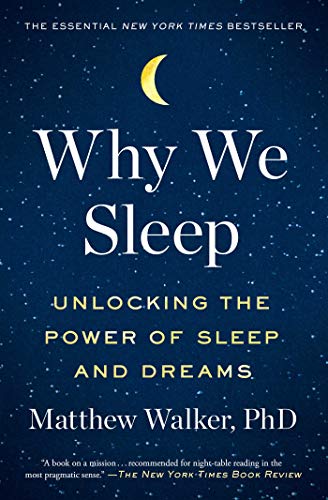
Why We Sleep - Unlocking the power of sleep and dreams, by Matthew Walker, PhD

My whole life I've been one of those people that considered sleep a little bit of a waste of time. Leaving time management issues asside, it seemed to be an obstacle that hindered productiveness; something that took away many hours that could be put into doing many other things, even for recreation. It seemed like a weakness of the human beings. This book has changed my vision.

From the very beginning of this book, you can tell that the author is completely passionate about the topic of sleep. Fortunately, even though there is some scientific terminology in the book, the author has made it very easy to digest, and communicates the ideas effectively. The book is not just a bunch of theories or opinions from the author; every chapter is built on different studies from different scientists, so the full content comes across as a very serious topic, that can persuade skeptics like me. On some of the studies I would try to skip ahead and start thinking about flaws in the study, and immediately afterwards the author addresses those concerns, usually giving very solid conclussions.

Here is a summary of the contents of this book:

Are you getting enough sleep?

  • Could you fall back asleep at 10-11am if you tried to?
  • Can you function optimally without caffeine before noon?
  • Would you sleep way past your waking time if you didn't set an alarm?
  • Do you sometimes find yourself at your computer reading and re-reading the same sentence?

Dangers of sleep depravation

Negative effects on your brain

  • Sleeping 6 hours every night, for 10 nights in a row, make you as impaired as if you had been awake 24 hours straight. Even after 3 nights of recovery, your performance level might not be fully recovered.
  • People usually underestimate how their performance has deteriorated.
  • If you drive after sleeping only 5 hours, you are 3 times more likely to suffer an accident. If you drive after sleeping only 4 hours, this increases to 11.5 times.
  • After 22 hours of sleep depravation, you are as cognitively impaired as those who are legally drunk.
    • Being awake for 17 hours is similar to having a BAC of 0.05% (Blood Alcohol Concentration).
    • Being awake for 24 hours is similar to having a BAC of 0.10%.
    • The United States defines legal intoxication for purposes of driving as a BAC of 0.08%.
    • Driving impairments are seen at a BAC of 0.05%
  • Car crashes caused by drowsiness tend to be more fatal than those caused by alcohol.
    • If you fall asleep at the wheel, you stop reacting altogether; whereas a drunk driver still reacts, only slower.
    • Don't think that you can keep yourself awake at the wheel, and fight the sleep signals you body sends you. You must stop.

    Negative effects on your body

    • Short sleep has been associated with a significant increase of the risk to suffer a coronory heart disease.
    • Sleeping less than 7 hours a night increases the probability of gaining weight, and increases the likelihood of developing type 2 diabetes.
      • Inadequate sleep reduces the amount of the hormone that makes you feel full after eating, and on the other hand increases the amount increases the amount of the hormone that produces a desire to eat.
      • Your body becomes unable to manage the extra calories efficiently. It becomes less effective in absorbing glucose and maintaining the level of sugar in your blood.
    • Men with inadequate sleep have lower levels of testosterone. With lower levels of testosterone:
      • Men feel tired throughout the day
      • It is more difficult to concentrate on work tasks
    • Women working erratic hours have a reduced ability to get pregnant.
    • Pregnant women sleeping less than 8 hours a night are more likely to suffer a miscarriage.
    • The less you sleep, the more likely you are to catch a cold.
    • Sleep disruption may increase the risk of cancer development, and may favour its rapid growth.
      • The World Health Organization has classified nighttime shifts as a "probable carcinogen".

    The evolutionary benefits of sleep

    Sleep is not a weakness. Every species sleeps, but evolution has made us the most advanced species, in great part thanks to the way we sleep. One shouldn't wonder about what are the benefits of sleep, but rather the other way around: are there any biological functions that don't benefit from proper sleep?
    • Sleep helps in our ability to learn
      • Sleeping before learning prepares your brain to make new memories
      • Sleeping after learning helps to cement the new memories considered important, and also to forget those considered irrelevant (keeping free space available for the important memories)
      • Sleep also works as a recovery service for things that could otherwise be forgotten.
      • Regarding motor skills, 
        • your brain continues to improve those skills in the absence of practice. When trying to play a difficult piece of piano that you cannot play before going to bed, you might find that it is a lot easier after sleeping.
        • You can get 20% improvement in performance speed, and 35% of improvement in accuracy.
    • Sleep helps us make logical decisions
    • Sleep helps us navigate social and psychological challenges
      • Dreaming takes the pain out of difficult emotional episodes; i.e., it isn't "time" alone which heals all wounds... it is time spent dreaming.
      • Dreaming helps us in tuning our internal decoder of emotions in facial microexpressions.
    • Dreaming provides us with creativity and problem solving skills
      • While we sleep, our brain looks for associations that wouldn't be obvious while we are awake.
    • Sleep strengthens our cardiovascular health
    • Sleep strenghtens our entire immune system

    How should we sleep?

    • Ideally, studies keep showing that we should sleep 8 hours. As you start sleeping less than that, you start losing the benefits of sleep, and start suffering the consequences. Humans need at least 7 hours to maintain cognitive performance, which is the minimum recommended by the CDC.
      • There is no sleep credit. You cannot really recover 100% of the sleep you have lost.
    • We should wake up every day at the same time, even on weekends. Maintain a stable sleep schedule.
    • Don't use alarm clocks. Your body is capable of logging time with a remarkable precision while you are sleep. If you keep a stable sleep schedule, your body will wake up at the same time every day (Of course, if you need to get to the airport at 4am, you should use an alarm). It is even recommended to use alarms the other way around: set the alarm to indicate that it is time to go to bed. 
      • Waking up with the sound of an alarm can cause spikes in your blood pressure and your heart rate.
      • Never use the "snooze" button. It would repeate those spikes over and over again.
    • If you like to exercise at night, you should do it at least 3 hours before you go to bed.
    • Avoid alcohol drinks before bed. It dramatically reduces your sleep quality. 
      • Even if it knocks you out, you are not getting a naturalistic sleep, with all its benefits, especially from REM sleep.
      • Drinking 3 days after learning something new would dramatically cause a loss of those things you learned, after you would think that those memories are safely stored in long-term memory.
      •  It takes too many hours for your body to degrade the alcohol.
    • Avoid large meals before bed. They also have an impact on your sleep quality.
    • Take a hot bath before bed. Your body feels sleepy after the drop in body temperature.
      • Washing your face also helps you sleep better, because it also helps to decrease your body temperature.
    • Get rid of anything in your bedroom that might distract you (TV, cell phone, computer, clocks, etc).
      • Ideally, you should turn off devices 2 hours before going to bed. The light from the devices messes up with how your body produces the hormones that help you sleep.
      • This especially happens with blue LED light. Most devices and screens have "eye saver" modes that reduce the amount of blue light. You must definitely use that, but it is just a little help, a damage control mechanism, that doesn't remove the need to turn off the devices way before bedime.
    • Don't lie awake in bed. If you are more than 20 minutes in bed without falling asleep, get out of bed.
    • Get at least 30 minutes of natural sunlight every day.
      • Senior citizens should go out in the late afternoon, to push their bedtime to a later hour.
    • Get a midafternoon short nap, before 3pm. Biphasic sleep is not cultural in origin, it is deeply biological, even though only some cultures have maintained it. All humans have a genetically hardwired dip in alertness that occurs in the midafternoon hours. Our society has driven us away from that biological need, and most people end up drinking caffeine.
    • Avoid caffeine
    • Avoid sleeping pills

    Changes in sleep across our life span (important for parents)

    • NREM/REM sleep
      • A 1 year-old has 50/50 NREM/REM sleep, across 14 hours of sleep
      • A 5 years-old has 70/30 sleep, across 11 hours
      • Late teens: 80/20, across 8 hours
    • Circadian rhythm:
      • Our circadian rhythm changes through our life span; sometimes it shifts forward, sometimes backwards.
      • Young children need to go to sleep earlier than most adults.
      • Adolescents need to go to sleep later than most adults.
        • Asking an adolescent to get up at 5-6am to go to school could be equivalent to asking an adult to get up at 3-4am to go to work. Most people are not aware about this biological reality and what our societies are asking us to do with our children. Many parents end up criticizing their children for not going to bed early, at a time when their bodies are signaling them that it is not yet time to sleep.
      • Senior citizens need to go to sleep earlier than most adults.
        • Older adults do not need less sleep, as some people think. They are just not able to generate it. 
          • By your late 40s you would have lost 60%-70% of the deep sleep you were able to get when you were younger. 
          • By your 70s, you would have lost 80%-90%
        • Ideally, they should get sunlight exposure late in the afternoon, to delay the release of melatonin, and therefore push bedtime to a later hour, increasing sleep pressure, and helping get a better sleep quality.

    What our societies are doing wrong

    Caffeine

    • This is the most widely used drug. It is highly addictive, and many people give it to their children and teens.
    • Caffeine blocks and inactivates the receptors of the chemicals that build the sleep pressure that makes us want to sleep. Therefore, it just numbs your body and tricks it into thinking that you don't need to sleep.
    • The chemicals continue to build up even under effects of caffeine; you just don't feel it. Once your liver dismantles the caffeine, all of a sudden your are hit with the complete sleep pressure that has been building up (a "caffeine crash"). What do most people do? They get another dosis.
    • It can take between 5-7 hours for your body to remove 50% of the caffeine. Therefore, drinking coffee at 5pm, could mean that at midnight you still have a lot of caffeine in your body, causing a lot of people problems in getting the proper sleep quality.

    In the Workplace

    • Shorter sleep predicts lower work rate and slow completion speed of basic tasks.
    • Sleepy employees generate less accurate solutions to work-relevant problems.
    • When you are not getting enough sleep, you work less productively and thus need to work longer to accomplish a goal, which can create a loop.
    • Individuals also like their jobs less when sleep-deprived; i.e., they are less motivated.
    • The less an individual sleeps, the more likely they are to lie the following day, and more likely they are to blame other people for their own mistakes, or to try to take credit for other people's work, which is not good to build a harmonious work environment
    • The amount of sleep can affect the leader's ability to lead effectively. The lower the quality of sleep that a supervisor gets, accurately predicts a poor self-control and abusive actions toward employees the following day. Those employees feel less engaged in their jobs throughout that day, even if they themselves are well rested. It works as a chain-reaction effect.
    • You want to turn your employees from simply looking busy yet ineffective, to being productive, honest, useful and inspiring.

    In Education

    The schedule of our schools make us interrupt the sleep of our children, preventing them to get the full benefits of a good night sleep, especially those related to learning

    • Most schools have schedules that are completely wrong:
      • 80% of schools begin before 8:15am
        • 50% of those, start before 7:20am
      • Many children and teenagers have to wake up at 5:15-5:30am to catch the bus for those early classes.
      • Considering that teenagers have their circadian rhythm shifted forward, this would be equivalent to adults waking up at 3:15am, every day of the week. 
      • Most of them have to use alarms to wake up so early
    • By interrupting the latest stages of sleep, we mostly interrupt REM sleep
      • Interrupting REM sleep causes psychosis: anxiety and hallucinations
      • Describe the symptoms produced by sleep depravation to a psychiatrist without informing the context, and they will give diagnoses of depression, anxiety disorders, and schizophrenia. 
    • Over 70% of parents believe their children are getting enough sleep, but the reality is that only 25% aged 11-18 are.
    • Many children with lack of sleep are being diagnosed with ADHD, and given drugs they don't really need. There is an estimate that over 50% of children diagnosed with ADHD actually have a sleep disorder.
    • You can see the effect of sleep in twins. A twin with a longer sleep pattern is superior in intellectual and educational abilities, with higher scores in standardized tests of reading and comprehension, and a more expansive vocabulary.
    • We are creating a generation of disadvantaged children.
    • Shifting school schedules would also have other benefits
      • Starting later, also means returning home later; i.e., reducing the window between children returning home from school and parents returning home from work. 
      • It also reduces traffic accidents from teenagers driving without enough sleep

    In Medicine

    It turns out that the person who founded the surgical training program at Johns Hopkins Hospital was a cocaine addict, and he inserted his unrealistic wakefulness into the program. Nowadays there is a lot of data about how the performance of doctors and nurses decreases after working long shifts without adequate sleep. Is important to not that no amount of years on the job can help a doctor to learn how to overcome the lack of sleep.
    • Residents working 30 hours shifts make 36% more serious medical errors, and 460% more diagnostic mistakes in the intensive care units
    • 20% of residents make a medical error that causes liable harm to a patient
    • 5% of residents will kill a patient, due to lack of sleep
    • They are 73% more likely to stab themselves with a needle or cut themselves with a scalpel
    • Their chances of being involved in a car accident driving home increases 168%

    The Subtle Art of Not Giving a F*ck, by Mark Manson

      Personal Review As the title implies, the book is written in a very free style, so the author communicates with the reader as if you were ...